
Literacy in Four Steps
Next Step – Alphabetic Fluency
The Iterative Process – Where the Rapid Happens
The Alphabet – Start Here
The journey towards literacy starts with the alphabet. Our “ABC Song For All Ages” sing-along video is designed to teach the alphabet in a relaxed and chill way.
The alphabet song is sung slowly at first without music, then sung again slowly with piano accompaniment, then sung at a faster pace, and finally the letters are presented without the narrator singing along so the student can practice. Both upper and lower case letters are shown.
This song is ideal for younger and older students, adults, English as a Second Language (ESL) and English Language Learners (ELL) that want to start learning how to read. Also see our recommended games list below.
The ABC Song for All Ages Sing-Along
We also have an alphabet sheet you can download to “Follow Along with the Song.”
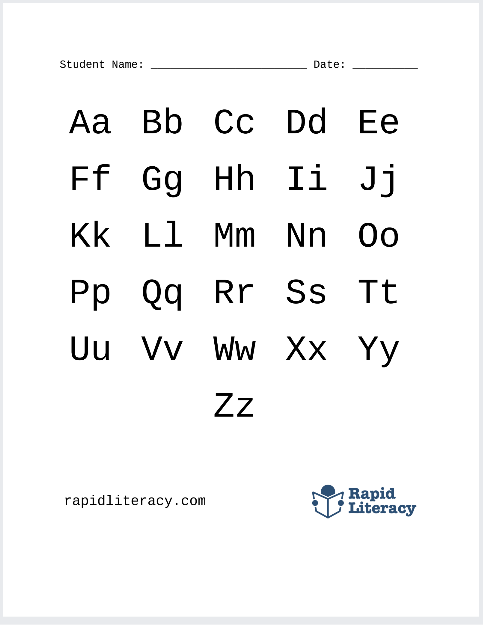
ABC Song For All Ages - Worksheet 1
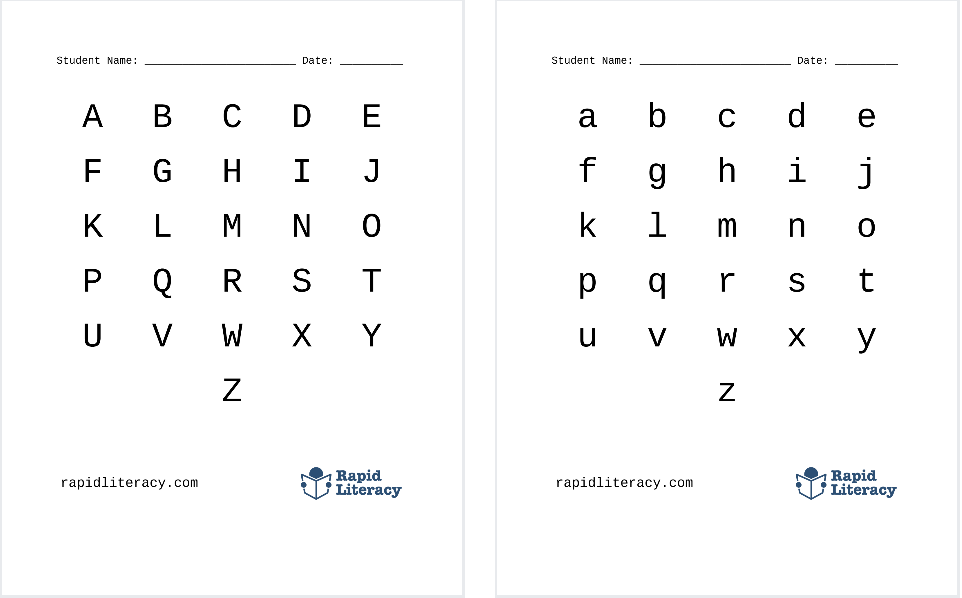
ABC Song For All Ages - Worksheet 2 and 3
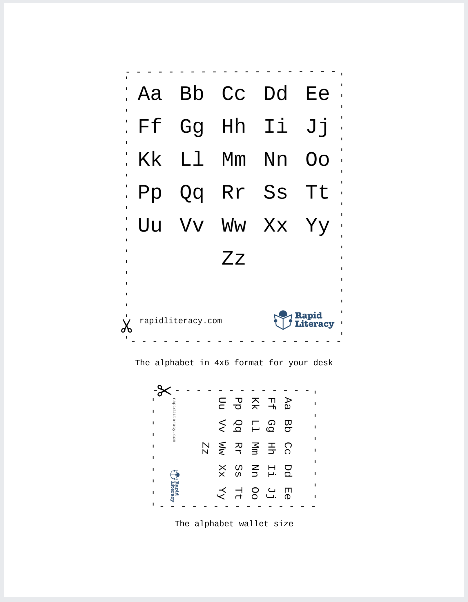
ABC Song For All Ages - Worksheet 4
Games
PLEASE NOTE: When I first published this site, the games listed below on abcya.com were free. Unfortunately, ABCya has since begun charging for access.
As a reading teacher, I still believe these are some of the best and most effective educational games I have ever used for teaching early literacy—particularly for students with dyslexia. Their math games as well can help students with early math skills, especially students with dyscalculia.
In my experience, an ABCya membership is well worth the cost. I’m also working to see if I can arrange a discount code specifically for Rapid Literacy site users.
Games are a wonderful way for students to master the alphabet. Plus, they help the teacher keep instruction consistent. You can also see how long it takes for each student to master the games. That is good data to have. Try these:
The alphabet order game. Start with this one.
The alphabet slider puzzle. Can you get the alphabet in order in under 100 moves?
The alphabet bingo game. Collect all the alphabet bugs! An absolute favorite.
The alphabet bubble game. Can you drop the letters in the right place?
The alphabet slider game. Can you make the picture?
The adventure man (or girl) game. Get ready for alphabetic fluency with this game.
Once the alphabet is mastered it’s time to build your alphabetic fluency.
Next Step – Alphabetic Fluency
The Alphabetic Fluency Chart: Your Most Powerful Tool
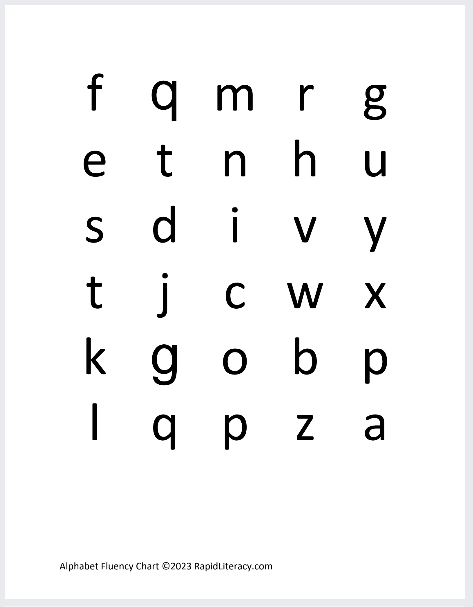
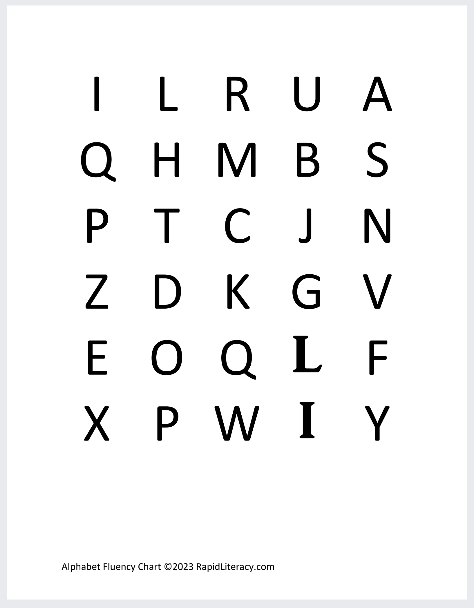
Fluency charts, using upper and lower case letters out of order, along with different fonts, help students master the letters beyond the “ABC” song.
Fluency Charts can also help students with dyslexia make the neurological connections necessary to identify letters.
How to Use the Alphabetic Fluency Chart
After students are confident with the ABC Song begin teaching the alphabet with the letters out of order using the fluency chart above. Have the students practice reading the letters across, sideways, backwards, and up and down.
Students will need to practice every day, and for students with dyslexia, complete mastery of the letters can take months, or even even years, as they move on to letter sounds, words, and sentence writing.
As students become confident with the letters, then move on to letter sounds and the blending of CVC (consonant vowel consonant) words. (More materials coming soon.)
The Iterative Process – Where the rapid happens
Even after knowing just a few letters, letter sounds, and CVC words, learning to read can now become an iterative process:
- Learning the alphabet.
- Learning the letter sounds.
- Decode (sound out) consonant-vowel-consonant words.
- Writing sentences.
No need to have all the letters and sounds mastered to start the iterative process; start with what the students know. The most important thing is to get students to see how words can be used.
Writing sentences is also where, under the teacher’s guidance, students begin to take ownership of their work. By writing sentences on topics they are interested in, they can begin to express themselves creatively.
Having students read their work to parents and their classmates provides a tremendous boost to their self-esteem and confidence.
The Rapid Literacy Iterative Reading Process:
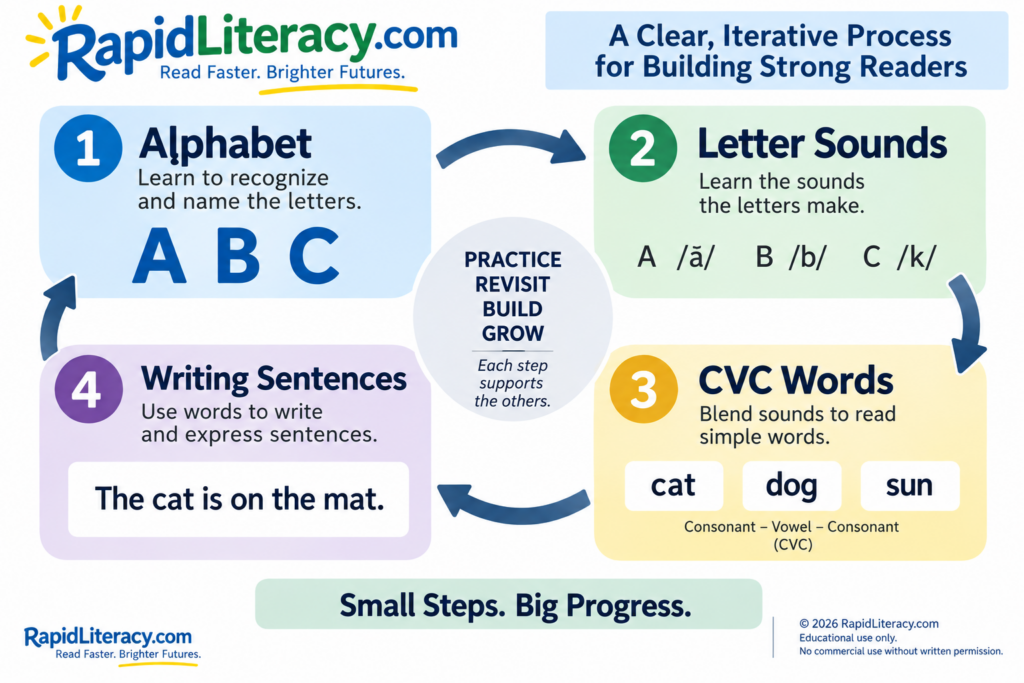
Repeat the four steps, each lesson adding new skills, such as punctuation. English teachers will thank you as your students come to class with a basic knowledge of sentence mechanics, further increasing their learning rate.
Other skills to teach as part of the iteration process include spelling. This can be taught by “encoding”, the reverse of decoding: rather than turning the letters into letter sounds, with encoding you turn the letter sounds back into letters. (You go from Step 2 to Step 1 on the chart above.)
Learning word pattern recognition, such as those found in digraph words (sh, ch, ck, words for example, e.g. “check”) can rapidly increase a student’s vocabulary.
And if you really want to take your teaching to the next level, teach students how to diagram sentences.
Lesson Structure
The key to a good early reading lesson is the four step process stays the same, but the skills become more challenging. Of course as the students master the alphabet, you can replace the first step with vocabulary and definitions, the second step with syllabication and root words, and so on.
I’ve found the four steps are ideal for the first part of a lesson, then reading stories with comprehension questions, or working on writing, are good for the 2nd half of the lesson.
Keeping the lesson structure consistent builds upon what the student did in the 1st half in the 2nd half, and there is only one lesson transition. I usually give a break in between the two parts of the lesson if the lesson is an hour.
Skills build upon skills, and progress from reading and writing sentences, to reading and writing paragraphs, pages, essays, papers, and so on.
This is why reading and writing need to be taught together.
These skills – letter names, letter sounds, blending, and sentences – will now begin to reinforce each other, but the alphabet is the critical first step as you learn to read.
More details about these additional steps will be coming soon.
– Rapid Literacy
Questions?
rapidliteracy@gmail.com